- Published on
An Intelligence Clear and Luminous as Ghee:
Introducing Vāyu, Indra, Mitra, and Varuṇa (Rig Veda 1.2)
- Authors

- Name
- Maa's Beloved
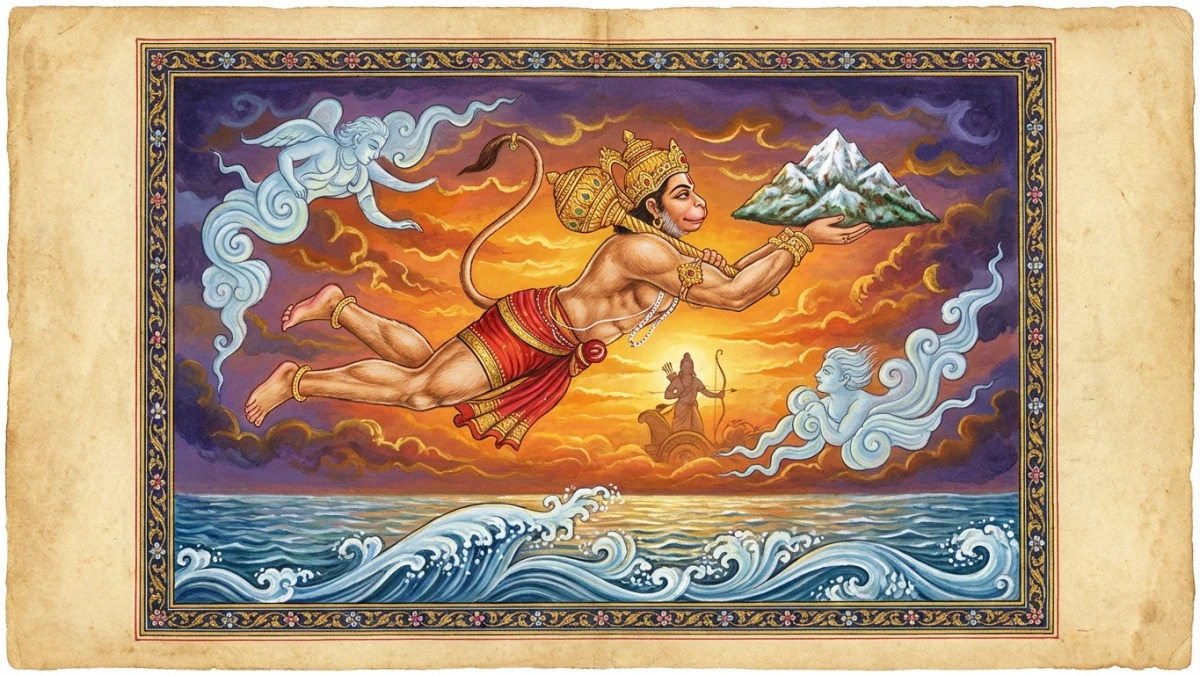
Lord Hanuman, son of Vāyu, flying a Himalayan mountain bearing a rare medicinal herb called Sanjīvanī across the ocean to save prince Lakshmana's life.
We previously studied Rig Veda 1.1, the Agni Suktam, in which Agni, the Divine will within all beings, is introduced. This next hymn proceeds to introduce the gods Vāyu, Indra, Mitra, and Varuṇa, and includes the first mention so far of the mysterious Soma offering. We'll consider each of these one-by-one.
Rig Veda 1.2
vāyo ǀ ā ǀ yāhi ǀ darśata ǀ ime ǀ somāḥ ǀ aram‑kṛtāḥ ǀ teṣām ǀ pāhi ǀ śrudhi ǀ havam ǁ (1.2.1)
O handsome Vāyu, come; this Soma is prepared and ready. Drink it; hear our call.
vāyo ǀ ukthebhiḥ ǀ jarante ǀ tvām ǀ accha ǀ jaritāraḥ ǀ suta‑somāḥ ǀ ahaḥ-vidaḥ ǁ (1.2.2)
O Vāyu, with their hymns, the lovers, the Soma‑pressers and knowers of the Day, sing praises to you.
vāyo ǀ tava ǀ pra‑pṛñcatī ǀ dhenā ǀ jigāti ǀ dāśuṣe ǀ urūcī ǀ soma-pītaye ǁ (1.2.3)
O Vāyu, your abundantly flowing, nourishing stream, moves towards the giver, wide for the drinking of Soma.
indravāyū ǀ ime ǀ sutāḥ ǀ upa ǀ prayaḥ‑bhiḥ ǀ ā ǀ gatam ǀ indavaḥ ǀ vām ǀ uśanti ǀ hi ǁ (1.2.4)
O Indra‑Vāyu, come with your delightful things to this pressed Soma. The Soma drops desire you both indeed.
vāyo ǀ indraḥ ǀ ca ǀ cetathaḥ ǀ sutānām ǀ vājinīvasū ǀ tau ǀ ā ǀ yātam ǀ upa ǀ dravat ǁ (1.2.5)
O Vāyu and Indra, rich in strength and abundance, you two perceive the pressed Soma. Come you two, hasten near!
vāyo ǀ indraḥ ǀ ca ǀ sunvataḥ ǀ ā ǀ yātam ǀ upa ǀ niḥ‑kṛtam ǀ makṣu ǀ itthā ǀ dhiyā ǀ narā ǁ (1.2.6)
O Vāyu and Indra, come to the perfected [offering] of the Soma‑presser. Come quickly, O heroes, with inspired thought.
mitram ǀ huve ǀ pūta-dakṣam ǀ varuṇam ǀ ca ǀ riśādasam ǀ dhiyam ǀ ghṛtācīm ǀ sādhantā ǁ (1.2.7)
I call upon Mitra, of purified discernment, and Varuṇa, who devours our hurters, who together establish an intelligence that is clear and luminous as ghee 1.
ṛtena ǀ mitrāvaruṇau ǀ ṛta-vṛdhau ǀ ṛta-spṛśā ǀ kratum ǀ bṛhantam ǀ āśāthe ǁ (1.2.8)
By Truth, Mitra and Varuṇa, who are increasers of Truth, who are in contact with Truth, have attained a vast will‑power.
kavī ǀ mitrāvaruṇā ǀ tuvi-jātau ǀ uru-kṣayā ǀ dakṣam ǀ dadhāte ǀ apasam ǁ (1.2.9)
The seers Mitra and Varuṇa, born in diverse ways and dwelling in wideness, uphold discernment in action.
Vāyu, the God of Wind
Vāyu, whose literal sense is the god of wind, is one of the few Vedic deities whose Vedic symbolism is largely preserved throughout the Upanishads and the later Hindu tradition. As the god of wind, Vāyu is intimately associated with the breath, and throughout the Hindu scriptures, the breath is understood to be directly tied to prāṇa, the life-force or animating energy by which all living beings are able to move, act, and exert themselves2. This is also the reason Hanuman, who is "prāṇa-nātha," Master of Prāṇa, and thus "atulita-bala-dhāmaṃ," an abode of unparalleled power, is also known as Vāyu-putra, the son of Vāyu. Speaking of Vāyu, the Chāndogya Upaniṣad declares most explicitly, prāṇastveṣa ātmana iti, "indeed, this [Vāyu] is the prāṇa of the Self." (Chāndogya 5.14.2). Vāyu thus represents that power of consciousness which manifests as prāṇa.
In light of this, we can understand why Vāyu is called darśata or handsome (1.2.1). In one who is full of prāṇa, we find that their skin has a kind of glow to it, their body is fit and full of vigor, their speech is clear and direct. Of course, then, Vāyu, who is prāṇa itself, can rightly be considered handsome.
The third verse of the hymn, however, will require a bit more careful analysis to tease out its significance. The verse speaks of Vāyu's "prapṛñcatī dhenā" (1.2.3). It is a well-known quality of Vedic Sanskrit that it has a strong capacity for and tendency towards wordplay, or in particular, having the same word simultaneously convey different meanings. In this context, the literal translation of "dhenā" is a nourishing cow, that is a milk-giving cow; however, "dhenā" also has the meanings "stream" or "river", and also sometimes refers to "voice" or "flowing speech". In each of these meanings of the term, there is a common sense of some kind of "flow" that is "nourishing," whether it is the flow of nourishing milk, water, or speech. And this general sense is definitely appropriate here. Certainly, the in-flow of prāṇa is experienced by us as a nourishing stream, as the life-giving energy which fills us and through which our five jñānendriya's (sense organs) and five karmendriya's (organs of action) function. Prāṇa is not an item or object which we can either possess or not possess, but is rather the unified current of energy which flows through us and all beings, in which all movement is supported. In the Praśna Upaniṣad, Prāṇa declares, "Do not fall into delusion. I alone, dividing myself fivefold, support this body and uphold it3" (Praśna 2.3). In the Chāndogya Upaniṣad, it is said, "just as the spokes of a wheel are attached to the central hub, in the same way all things rest upon Prāṇa" (Chāndogya 7.15.1).
And so this hymn speaks of Vāyu's prāṇa as his "prapṛñcatī dhenā" (1.2.3), his abundantly flowing, nourishing stream or river. But what about the other two senses of the term "dhenā"? In the ritual form of the Vedic yajña, the primary use of prāṇa is to redirect the energy back to the gods through speech and the singing of hymns. Verily, in the yajña ritual, it is through speech, which is none other than the flow of prāṇa through the vocal organ, that Agni as the hotṛ voices the call to the gods (RV 1.1.1). In this sense, we can understand Vāyu as supporting the yajña through his prapṛñcatī dhenā, his abundantly flowing speech or voice. But as is typical with the Vedas, each aspect of the Vedic ritual is symbolic of the fuller yajña that is the process of Yoga itself. In Yoga, we offer not only our speech, but the entire flow of prāṇa through all our sense organs and organs of action to the divine. So the support Vāyu grants in the yajña through speech is in truth granted through the whole of action and movement itself.
Finally, we must consider the most literal meaning of dhenā as a nourishing cow, in particular one overflowing with milk. The Vedas are filled with deep animal symbolism, and typically (but not in all cases), animals represent the manifestation of divine treasures on earth. They are the rayim, inner treasure (RV 1.1.3), and the ratna, spiritual jewels and riches (RV 1.1.1), which Agni bears, the manifestations of knowledge, vastness, force, purity, compassion, mystical intuition, and so on. The most common symbol in the Vedas of these divine manifestations or treasures is the cow. In fact, the Sanskrit word for cow, "go", also means "light" or "ray". The cows are the manifested rays of the divine light and Truth, symbolized by Sūrya, the sun. While the horse is the more direct symbol in the Vedas of prāṇa, of force or cit-śakti, the power of consciousness, prāṇa is also appropriately seen as a cow, for it is to us a divine treasure, a manifestation of an inherent aspect of Truth. And so, Vāyu's prapṛñcatī dhenā can also be understood as his abundantly flowing, nourishing cow of prāṇa.
Soma, the Delight of Existence
Now, returning to verse 1.2.3, the hymn declares that Vāyu's prapṛñcatī dhenā, his overflowing current of prāṇa, moves towards the giver for a particular purpose: for the drinking of Soma (soma-pītaye) (1.2.3). In the Vedic yajña ritual, Soma is the pressed juice of the Soma plant, and is the central offering presented to the gods. The Vedas are filled with vivid imagery describing how deeply the gods delight in Soma, and how they hasten to the yajña to drink it.
What is this Soma that the gods come rushing to the yajña to drink? In the modern day, there is much obsession with identifying the Soma plant that the ṛṣi's used in the yajña ritual, with many believing it was a hallucinogen. Sri Aurobindo, T. V. Kapali Sastry, and R. L. Kashyap make, I believe, relatively convincing arguments against this hypothesis. But as the goal of these commentaries is to elucidate the underlying adhyātmic or spiritual vision of the Rig Veda, these questions are better left for another study. What is clear is that the true Soma, to which all beings, gods or men, are drawn, is not a gross sap or juice, but something more subtle that must be discerned. The Rig Veda declares,
"One thinks one has drunk the Soma, after one has crushed the herb; None ever drank of the Soma known to the men of wisdom." (RV 10.85.3)
So again we ask, what is this Soma, known to the Vedic seers? What does the entire universe strive unceasingly towards? The answer is Delight. Not some fleeting delight or pleasure which leaves us thirsting, but that eternal delight, that rasa, sweet essence, which is intrinsic to Truth itself. As St Augustine says, crying out to God, "Our hearts are restless till they rest in Thee" [16]. The Indian tradition, recognizing this ānanda or bliss to be inseparable from Truth, describes the ultimate Reality as sat-cit-ānanda, Existence-Consciousness-Bliss. I'm reminded here also of Aristotle's unmoved mover, which moves the entire universe not through force, but through the rest of the universe's intrinsic longing for it [14]. I believe there is also significance in the fact that Soma is enjoyed in the yajña at the meeting point of the gods and man. Soma is the Delight of Yoga, of the communion of the individual with the divine, of the Self (Atman) with Brahman. It is the joy of unity fully established in multiplicity, the joy of love. So desirable is this union that the Taittirīya Upaniṣad says of the One pure consciousness, existing before time itself,
so’kāmayata bahusyāṃ prajāyeyeti
He desired, 'May I become many and be born' (Taittirīya 2.6)
And so, it is said, "He performed tapas (spiritual austerity or effort). Having performed tapas, He created all this, whatever exists here. Having created it, He entered into it. Having entered it, He became the manifest and the unmanifest, the defined and the undefined, the housed and the houseless, knowledge and ignorance, truth and falsehood. He became Truth. Indeed all this, whatsoever that exists, is called Truth" (Taittirīya 2.6). Speaking of all the One has become, the Taittirīya Upaniṣad continues,
"Therefore, they call it sukṛtam, the well and beautifully made. Lo, this that is well and beautifully made, verily it is no other than rasa, the delight behind existence. For having attained this rasa, one becomes blissful. For who indeed would breathe, who would live, if there were not that Bliss in the heaven of his heart, in ākāśa, the ether within his being." (Taittirīya 2.7).
Yoga, union, is the delight of existence. So wonderful is this delight, that the serene and pure One, without strife or affliction or confusion, performed a great yajña, a great sacrifice, and became the Many, so that He may gain the Many, and so that through this the Many may gain the One. This Delight of the union of Unity and Multiplicity is the essence of Soma.
Let us return to the text. Vāyu's prapṛñcatī dhenā, his abundantly flowing, nourishing stream of prāṇa, moves towards the aspirant, wide for the drinking of Soma (1.2.3). All the gods come to the yajña, supplying the powers they hold, for the delight of Soma, the delight which arises from the union of the divine, i.e., the gods, and the manifest, i.e., man. But what exactly is the role of man, of the aspirant, in this union? Our hymn gives us a few pointers here. Importantly, the Soma is not something simply brought and presented by the aspirant to the gods. Rather, the Soma must be made aram-kṛtāḥ, prepared and ready (1.2.1). It must be made into sutāḥ, juice that is pressed out and extracted by the Soma pressers, the suta-somāḥ (1.2.2, 1.2.4). It is to this perfected offering, niḥ‑kṛtam (1.2.6), that the aspirant calls the gods.
While the precise symbolism of each of the individual actions performed in preparing the Soma will be more accessible in later verses of the Rig Veda, we can at least infer the kind of work that may be necessary for the preparation of Soma. If Soma is the Delight of unity in multiplicity, of love, then what is needed to prepare this possibility? Perhaps what is first required is a one-pointed longing, which seeks none other than this union. In other words, vairāgya, dispassion which renounces all else in search of one pure aim. This longing "presses" into existence, seeking purely for that divine possibility or rasa. However, when this longing is applied, when we search for the divine, what is often found is not Truth, but a deeper recognition of our ignorance and egotism. It is said that the first fruit of spiritual life is not the recognition of Truth, but the recognition of error, of sin or avidyā [13]. And so, the Vedas declare, that once the Soma plant is pressed, the extract must be further purified by being passed through pavitram, a strainer or purifying filter (RV 9.83.1). As we search for the divine with one-pointed longing, we pass what we find through the purifying filter of viveka, careful discernment. By means of contemplation, awareness, and reason, we strain out the remaining husks of attachments or cravings feigning to be love.
And after the pressing and straining and purifying of the Soma, what remains? indavaḥ, droplets of the sacred Soma (1.2.4). But is this ready and perfected offering (1.2.1, 1.2.6) sufficient in itself, that we may now simply enjoy of its Delight? No, for the drops of Soma desire the gods, they desire Indra and Vāyu (1.2.4). Even if the conditions of Yoga are met in the aspirant, and the aspirant is situated in pure one-pointed longing, surrender, and contemplation towards the divine, it is still only when the divine too gives itself unto the aspirant that the Delight which arises from their union is enjoyed. If this were not the case, if the Soma could be prepared and enjoyed by the human alone, then Soma would be purely an earthly delight, not the fruit of the union of heaven and earth.
And yet, in another sense, the preparation of the Soma is sufficient. For just as the Soma desires the gods, the gods desire the Soma. And so, when the conditions of Yoga are met in the aspirant, when the Soma is ready and purified, the gods come hastily to join the aspirant in the yajña and enjoy the Soma. As Sri Ramakrishna says, "The winds of God's grace are always blowing, it is for us to raise our sails."
It is also worth meditating on the fact that after all the pressing and straining, what remains are but a few droplets of Soma (1.2.4). This again reminds us that Soma is not a gross substance that we can easily access through gross means, but is the most subtle Delight. That supreme union towards which all creation strives is a subtle Delight. So subtle is this Delight that one may be unsure that it even exists. Who knows about these mysterious golden drops of Soma? Perhaps it's just husk all the way down. For this reason, the ṛṣi's who perform the yajña, who press the Soma, are also called ahaḥ-vidaḥ, knowers of the Day (1.2.2).
The concept of ahaḥ or "the Day" is a very pervasive symbol throughout Vedic language. There is much to say about it that we will leave for discussions on later hymns, but for now, it'll be enough to point out that in the Vedas, the Night frequently represents that condition or awareness in which one is afflicted with ignorance, sin, and a sense of separation from the divine. In contrast, the Day is that condition in which the Sun of Truth has risen and has filled all darkness with light. The Chāndogya Upaniṣad declares, speaking of the Sun, udyan tamaḥ bhayam apahanti, "rising, he dispels darkness and fear" (Chāndogya 1.3.1). The Day is the vision of Truth and the experience of communion with the divine4. So, the priests of the yajña, who are lovers of the gods, who sing the hymns and press the Soma, are also knowers of the Day and the path which leads there (1.2.2). They are knowers of the gods and the hymns by which they are called, knowers of the right attitude and method for performing the yajña, and they are knowers of the subtle Soma which leads them to that cosmic Day. While only a few drops of Soma are offered by the aspirant in the yajña, in the cosmic Day, the fuller Delight, the fuller communion is manifested, and the aspirant drinks from that ocean of eternal Delight.
It can seem like a pretty high bar that we aspirants who perform the yajña must be knowers of the Day in this sense. Certainly we seek that Delight, but we are often unsure about the path which leads there, or even have doubts of its existence or possibility. But we have to remember again here that we are not alone. While most of the gods await the right conditions in the aspirant to provide their support in the yajña, there is one deva who is "team human" right from the very beginning. Agni, the child of heaven and earth (RV 3.1.3), is that divine will within us which is always seeking with us for that sacred union, that sacred Day (RV 1.1). By his birth from the heavens, he is divine, and is a kavi, a seer who is a knower of the Day and the path leading to it. And yet by his birth from the earth, he is joined to us in his very essence. He is always together with us, supporting our yajña and calling out to the gods.
At this point, it is helpful to note that while earlier we inferred one understanding of the Soma pressing and purification process in terms of vairāgya and viveka, it is the nature of the Vedas that its symbols often carry multiple intended interpretations, each of which is correct and sheds light on a different aspect of the underlying meaning. For example, in a simpler psychological interpretation, Indian thought typically understands all effort as a form of concentration. Whenever we act, we gather our consciousness around a particular aim and direct our faculties toward it. It is by concentration that even our motor faculties activate and our arms and legs move. Searching, working, contemplating, and creating are all ways in which consciousness concentrates itself upon a chosen object. In this light, the pressing of Soma can also be understood as the concentration of consciousness towards the divine or God or the Self. In another more practical interpretation, all spiritual practice, including selfless service, practicing non-attachment, meditation, devotional practices such as prayer, singing, and chanting, contemplation, scriptural study, breathing exercises, and fasting, all can be understood as part of the pressing and purification of Soma.
In an even deeper sense, however, we can see the pressing of Soma as something which has been happening throughout all creation. The Chāndogya Upaniṣad presents this mystical verse:
Of these beings, the earth is the rasa.
Of the earth, water is the rasa.
Of the waters, the plants are the rasa.
Of the plants, the human being is the rasa.
Of the human being, speech is the rasa.
Of speech, the Ṛig-verse is the rasa.
Of the Ṛig-verse, the Sāman chant is the rasa.
Of the Sāman chant, the Udgītha is the rasa. (Chāndogya 1.1.2)
While rasa is typically translated as "essence," it also carries the more specific sense of a "refined or distilled essence". For example, out of the seed grows the flower, from which can be extracted the rasa of nectar. The nectar is the refined essence of the flower and the seed, contained potentially within them, but needing to be grown and harvested out of them. In a similar sense, the Soma drops are the rasa of the Soma plant, needing to be pressed out and refined.
And so, we can understand the verse above as saying the following. When there is matter or stuff or "beings", earth is the rasa which is formed by pressing and refining that matter. When there is earth, water is the rasa which is formed by pressing and refining the earth. When there is water, plants are the rasa which are formed by pressing and refining the water (and earth). When there are plants, the human being is the rasa which is formed by pressing and refining that organic matter and plant-stuff. When there is the human being, speech is the rasa which is formed by pressing and refining the human being. When there is speech, the Ṛig-verse, the sacred chant of the Rig Veda which voices the call to the gods, is the rasa formed by pressing and refining speech. When there is the Ṛig-verse, the Sāman chant, the sacred melody and sound which infuses the Ṛig-verse with actual spirit and soul, is the rasa which is formed by pressing and refining the Ṛig-verse. Finally, when there is the Sāman chant (and the Ṛig-verse), the Udgītha, the upward Song, the complete synthesis of the Ṛig-verse and the Sāman chant into a pure hymn to the gods, is the rasa which is formed by pressing and refining the Sāman chant. And this Udgītha, this pure upward Song, is called rasānāṃ rasatamaḥ paramaḥ, the best essence, the rasa of all rasa's (Chāndogya 1.1.3), for in this Udgītha, the prepared drops of Soma are intrinsically and manifestly present. And so in this upward Song, the gods come rushing for union with man, and in it comes the manifestation of the Day, of the great Delight.
And now let us remember again that Agni is the child of earth, and so, as the Atharva Veda explains,
"Agni is in the earth, in the plants; the waters hold Agni in them; Agni is in the stones. Agni indeed dwells within human beings; Agni is in the cows and horses." (Atharva Veda 12.1.19)
And so, since the very beginning of creation, Agni, the seer and knower of the Day, has been engaged in pressing out the supreme rasa of Soma. In pressing the Soma, he has become earth, water, plants, human beings, speech, the verses of the Rig Veda, the chants of the Sama Veda, and verily, he has become the upward Song, the Udgītha, which brings the gods here and wins that glorious Day. And as Agni performs this cosmic yajña, he is also the support of the reflected yajña's within each individual. So the ṛṣi's and aspirants who perform the yajña are called suta-somāḥ, Soma-pressers, and ahaḥ-vidaḥ, knowers of the Day, by virtue of this Agni within them.
This is enough on Soma and its related symbols for now. Let us now take a look at the next verses on Vāyu and Indra.
Indra, the God of Thunder
The next three verses of the hymn, 1.2.4-6, are sung to Indra and Vāyu together. In the Vedas, the external presentation of Indra is as a mighty storm god who wields the great Vajra or lightning bolt as a weapon. What, however, is Indra's inner sense? The verses of this hymn give very little to penetrate into Indra's identity and power, and serve primarily as a preliminary call to Indra. It won't be until hymn 1.4 of the Rig Veda that we will get a rich and detailed hymn sung directly to Indra. Still, there are some significant insights we can draw out from this sub-hymn. In order to be able to do this, we will present a particular characterization of Indra's identity. We will study some evidence for this characterization in later hymns, particularly hymn 1.4; however, for now, let us take it for granted.
While Vāyu is the Lord of Life-Energy or prāṇa, Indra is the Lord of the Inspired Intellect (buddhi). He is the clear-seeing intellect of right understanding. As the fashioner of perfect forms, he fashions in us right thoughts through which we may have a right relation to the world and right expression within it. In our present state of darkness, we are filled with deluded thoughts. We think worldly pleasures will satisfy our inner craving. We pridefully think our achievements and successes to be won on our own strength. We hate and judge others all the while being deeply inflicted by ignorance ourselves. Indra is that discerning intelligence, which passes through such deluded thoughts to a more vast and holistic understanding.
With this understanding, we can now study the aforementioned verses. The hymn calls out to Vāyu and Indra, who are "rich in strength and abundance" (1.2.5), to "come with [their] delightful things" (1.2.4). Certainly, it is appropriate to call both Vāyu and Indra rich in strength and abundance. Vāyu's prāṇa is the source of all strength and is, as we discussed earlier, itself described as prapṛñcatī or "abundantly flowing" (1.2.3). Indra's strength, in contrast, is that of a sharp intellect, which can penetrate through false stories or forms and arrive at right understanding. His abundance lies in the manifold philosophical, symbolic, or mythic forms of thought he shapes in the intellect, which point toward the truth rather than conceal it. And the prāṇa and insightful thought which Vāyu and Indra bring are certainly delightful to us.
The hymn continues to exhort Vāyu and Indra, "come quickly, O heroes, with inspired thought" (1.2.6). The Sanskrit word translated here as "inspired thought" is dhī. As dhī is a root word that appears repeatedly throughout the Rig Veda, it will be helpful to develop a good sense of what it means. One of the meanings of dhī in Vedic Sanskrit is "intellect" or "intelligence". The root dhī also has the sense "to hold or contain", pointing to the intellect as that which holds or contains thoughts or forms. The word dhī also typically refers not to the abstract faculty of the intellect, but to its actual substance or activity. This aspect is perhaps reflected in translations of dhī as "thought" or "understanding". Finally, in Vedic Sanskrit, dhī doesn't mean mere intelligence or thought, but is always used to refer to an inspired or illumined intelligence / thought, one befitting a seer. This can be seen from the fact that in instances where the Vedas seek to refer to intelligence or thought in a more ordinary or generic sense, the word "mati" is used instead, relating to the word "manas" meaning mind.
But we may also ask now, why are we calling out to both Vāyu and Indra here? Is it not Indra, the Lord of the Intellect, who brings inspired thought? In the Vedas, there is always insight to be drawn from paying attention to small details like word-choice, order, and pairings of deities. In this hymn, there is crucial significance to the fact that the first hymn to Indra is sung after hymns to Vāyu, and even then sung also to Vāyu. For a fluid and pure intelligence sits on top of the support of strong prāṇa. Without the energetic support of prāṇa, the mind grinds to a halt and is lethargically flustered by non-sensible delusions. With prāṇa, one is able to swiftly and firmly recognize situations as they are and act accordingly. And so we call Vāyu and Indra to come together quickly, bringing with them the inspired thought which they together support.
The significance of order in this hymn continues into the call to Mitra and Varuṇa. Even if, with the aid of Vāyu and Indra, one is established in a strong and pure intelligence with right understanding, one may, as I argue in Reconciling Sin and Avidya, Part 1, still find themselves drawn toward and unable to separate from sin and delusion. One may (intellectually) know what is right and true, and yet still be afflicted by addiction, anger, vengefulness, lust, jealousy, etc. The mind, friends, is a tricky thing. And so we call upon Mitra and Varuṇa to aid us, so that our intelligence may not remain within itself but pervade and transform our entire being.
Mitra and Varuṇa, the Divine Helpers
The final triplet of this hymn is dedicated to Mitra and Varuṇa, and begins with the following verse.
"I call upon Mitra, of purified discernment, and Varuṇa, who devours our hurters, who together establish an intelligence that is clear and luminous as ghee." (1.2.7)
Varuṇa is described as riśādasam, he who devours (adas) those who injure or harm (riś). The Vedas and later Hindu scriptures consistently recognize the presence of tendencies or forces, both within us and in the world, of untruth and darkness, often personified as demons or asuras. These hostile forces are not single, but greatly diverse in character and approach. In fact, it is said that in terms of pure number, the asuras out-number the devas. The Bṛhadāraṇyaka Upaniṣad states, "There were two classes of Prajāpati's sons: the gods and the asuras. Naturally, the gods were fewer, and the asuras more in number" (Bṛhadāraṇyaka 1.3.1). The asuras include dviṣ, arāti, rākṣasas, yātus, ayajvans, dasyus, the Paṇis, and demons like Vṛtra, Śambara, Vala, and Namuci, among many others. These are forces which withhold, conceal, distort, corrupt, deceive, and manipulate. Varuṇa, then, is the inner slayer of demons5. He devours and destroys those forces within us which draw us away from unity.
However, destruction is not the only law of healing. Not every ignorant form or tendency within us is meant to be utterly destroyed. Sometimes the ignorant form hides within it an essence or nugget of truth. Mitra is described in the above verse as pūta-dakṣam, as having purified (pūta) discernment or mental faculties (dakṣa). This description, however, isn't immediately helpful, as it would also apply to Varuṇa and Indra. A more helpful hint towards Mitra's identity is his name. Mitra, in Sanskrit, means friend, but in older forms or roots of the word, it has been argued by scholars to also have the meanings "agreement", "covenant", or "to bind". Mitra, then, as Sri Aurobindo argues, and as we will find further evidence for in later hymns, is the power that brings into harmony. He takes disparate disagreeing parts, finds within them their hidden truth or unity, and brings them into agreement, harmony, and friendship.
Let's consider an example. Lust is universally recognized across spiritual traditions as a pervasive cause of spiritual downfall. An aspirant may, by means of discernment, recognize lust as drawing them away from God, and thus have the impulse to entirely destroy this tendency within them. However, it's possible that in utterly destroying lust from its root, we simultaneously destroy or repress that within us which desperately longs for union with the divine. Lust, perhaps, is precisely the degenerated form or ignorant manifestation of that truer inner longing. Sri Ramakrishna instead taught the following:
"Direct the six passions to God. The impulse of lust should be turned into the desire to have intercourse with Atman. Feel angry at those who stand in your way to God. Feel greedy for Him. If you must have the feeling of I and mine, then associate it with God. Say, for instance, ‘My Rama, my Krishna.’ If you must have pride, then feel like Bibhishana, who said, ‘I have touched the feet of Rama with my head; I will not bow this head before anyone else.’"
At one level, this teaching can be understood as a pragmatic necessity. One should utterly destroy lust, anger, greed, and pride within them, but this is typically not possible, so we should at least turn these tendencies towards God, with the understanding that in doing so, they will inevitably fall away with time. This reading is supported by the fact that Sri Ramakrishna qualifies his advice with, "if you must have feeling of I and mine, ..." and "if you must have pride, ..." Another reading, however, understands this teaching as implicitly situated within the wisdom that Yoga is essentially about transformation. That in Yoga, the degenerated and corrupting force of lust is not to be annihilated, but must be purified and transformed, revealing the pure longing which underlies it. Anger must be purified and transformed, revealing the firm rejection of evil, stagnancy, and falsehood which underlies it. Greed must be purified and transformed, revealing the urge for expansion out of all finitude into the vast Infinite which underlies it. Pride must be purified and transformed, revealing the true Self-love which underlies it. In this reading, directing the passions to God is a movement which supports the process of their transformation. In contrast, attempts to annihilate the passions directly are doomed to fail, since the purified longing and force underlying them is essential to our nature, and thus cannot be destroyed. Such attempts at best repress this force, in which case the unresolved ignorance inevitably resurfaces later, often with greater intensity.
But now, if we meditate further on this process of transformation, I believe we can discover an even deeper complementarity between the roles of Mitra and Varuṇa. So far, we have presented Mitra and Varuṇa as two faculties for healing, one of harmonization and another of destruction. But in truth, these are two aspects of the same movement. Whenever there is a tension between two parts or tendencies in oneself, if harmonization reveals the inner truth hidden within both parts, in which the tension dissolves, then destruction destroys the old and dry shells or forms which covered those truths. Destruction is essential to harmonization, as without it, the old forms and their internal contradiction or tension would remain. Varuṇa destroys our clinging to old forms or ways of life, allowing for the manifestation of new harmonies which better penetrate truth. Notably, these lingering tendencies are not mere inconveniences, but are to us hurters which keep us distanced from our own Self. It is these hurters which Varuṇa devours.
And conversely of course, it is in its relation to harmonization that destruction goes from being merely a movement of death and decay to one which births life and immortality. Varuṇa does not destroy haphazardly, such that what remains afterwards is in ruins, but with the precision of a surgeon, with discernment. He recognizes, together with Mitra, that there is a hidden inner truth in things which his destruction preserves.
Here, we can now reconcile the two interpretations of Sri Ramakrishna's teachings from earlier. Insofar as lust, anger, greed, and pride refer to degenerated forms of the underlying force which drives them, then they are not to be destroyed but harmonized with the divine aspiration within us and transformed. But if they refer not to this force but, as the Gita describes, to the covers which obscure and misdirect its expression, as smoke covers a fire and dust masks a mirror (Gita 3.38), then truly, they must be destroyed for the possibility of transformation, albeit with care to preserve what's underneath. This harmonization and destruction, the shared work of Mitra and Varuṇa, together support the movement of Yoga, which cleanses away falsehoods and simultaneously forms and reveals the Divine Child, the Son of Infinity.
Let us consider the other two verses on Mitra and Varuṇa. Since Mitra and Varuṇa together bring about new harmonies in our being which make more manifest the truths discovered by Indra in the intellect, they are called ṛta-vṛdhau, increasers of Truth (1.2.8). Similarly, they are also called ṛta-spṛśā, ones who touch or are in contact with Truth, and so the synthetic movement they support is truly guided by and directed towards the light of Truth (1.2.8). It is revealing here to note that the term spṛśā, which literally means "touch", typically has the connotation of a touch which satisfies, like the touch between intimate lovers. Truth in Vedic religion is never a dry conceptual philosophy, but is a source of deep satisfaction and delight. Mitra and Varuṇa, then, are in intimate satisfying contact with Truth, and reach out for further increase of Truth through supporting the development of deeper and deeper unity in multiplicity.
In fact, this description rightly describes all the gods in the Vedas. The two descriptors, ṛta-vṛdhau and ṛta-spṛśā, are used in various forms throughout the Rig Veda to refer to all gods. For example, we recall from our study of the previous hymn that Agni is similarly described as vardhamānam sve dame, increasing in his own home, which is none other than ṛtaṁ bṛhat, the Vast Truth (RV 1.1.8, 1.75.5). More explicitly, in Rig Veda 1.14.7, the hymn sings to all the gods together (viśvedevā), and refers to them collectively as ṛta-vṛdhau. And in Rig Veda 4.50.3, a hymn to Bṛhaspati, the ṛṣis sing, "O Bṛhaspati, those who are from the highest, most supreme summit (paramā parāvat), who are in contact with ṛta (ṛtaspṛśo), have now sat down here near you," and so the gods who join the aspirant in the yajña are described as ṛta-spṛśā.
And in their relation to Truth, indeed, through Truth (ṛtena), the verse declares that Mitra and Varuṇa attain kratum bṛhantam, a vast will-power (1.2.8). This reminds us of a central claim found across religious traditions that true freedom, true will-power, is attained in relation to Truth or God. The ignorant claim freedom when they are able to efficiently satisfy the whims of their ego, when they are at the heights of asuric power and can indulge freely, when they can buy whatever they want, sleep with whomever they want, command whatever they want, and destroy whatever they want. But wisdom tells us that ironically, it is often precisely in these modes that we are most deeply bound, and this painful truth hits us inevitably when, on the other side of the power trip, we find ourselves drained and unsatisfied. For many, this recognition is the beginning of spiritual life, of the search for Truth. For it is in relation to Truth that our expression comes into alignment with our deepest inner longing, and so we find true freedom and will-power6.
Continuing with the verses, since Mitra and Varuṇa are ṛta-spṛśā, in contact with Truth (1.2.8), they are also described as uru-kṣayā, dwelling in wideness (1.2.9), for the Truth is a wide and vast Infinity which one can actually commune with and live in. And since they are ṛta-vṛdhau, constantly engaged in the increase of Truth, they are rightly described as tuvi-jātau, born in diverse ways among the multitude beings of creation (1.2.9). In the same way as earlier, these descriptions also apply to all the gods.
Finally, the hymn ends by reminding us what exactly Mitra and Varuṇa support through their respective harmonization and destruction. The hymn says, dakṣam dadhāte apasam, they uphold (dadhāte) discrimination or skill (dakṣam) in action (apasam). Again, Mitra and Varuṇa ensure that the clear and inspired knowledge which Indra brings does not remain merely intellectual, but pervades the very substance of our every thought and experience, whether conscious or unconscious, and (with the help of the Ashvins, as we will find in the next hymn) translates into real manifest action. We are reminded here of the Gita, in which Sri Krishna declares "yogaḥ karmasu kauśalam," Yoga is skill in action. This dakṣam apasam can be understood to be precisely this 'skill in action' of the Gita. Mitra and Varuṇa together uphold in us a pure and luminous action firmly grounded in discernment and true knowledge.
Ṛtam and Satyam, Two Faces of Truth
Given that we have referred extensively to ṛtam throughout the above analysis, it will be good to wrap up by spending some time developing a deeper understanding of its significance. We translate ṛtam above as Truth, but how does this relate to satyam, which is also typically translated as Truth? A helpful way to understand the deep relation between satyam and ṛtam is by way of analogy. For example, consider the relationship between the inner experience of love and the outer expression of care. In an important sense, these two are inseparable. To truly love is to care, and genuine care always has love for its ground. Without love, care becomes merely a mechanical motion, done out of necessity or some other compulsion, and is thus no longer worthy of being called care. And without care, love becomes a mere self-contained, narcissistic solipsism, and likewise loses the right to its name7. Similarly, wisdom is inseparable from right action, the One Purusha is inseparable from his great yajña, light is inseparable from illumination. Most generally, essence is always inherently inseparable from its expression. Both are only understood in relation to each other. Sri Ramakrishna says,
"Brahman and Śakti are inseparable, like fire and its power to burn. When we talk of fire, we automatically mean also its power to burn. Again, the fire's power to burn implies the fire itself. If you accept the one, you must accept the other." (Gospel of Sri Ramakrishna, pg 108)
Given these analogies, we can now get a sense for ṛtam and satyam. Satyam is Truth in its essence, its interior substance, nature, or being, and ṛtam is Truth in its expression, in the myriad ways it unfolds or flows forth or becomes. By ṛtam, the planets move in their wide orbit (RV 10.92.4), the stars are set high above (RV 1.24.10), and the gods in the heavens fulfill their respective roles (RV 1.68.5). By ṛtam, the earth is upheld, the rain nourishes the plants, and from the plants emerge food which supports all the diverse ecosystems of life (RV 5.62.3). By ṛtam is formed dharma (RV 5.63.7), and particularly svadharma, the internal law or the unique right-expression proper to every individual being. By ṛtam has the Soma been pressed since all time, and by ṛtam, all beings proceed towards communion in God, in Truth (RV 6.9.5). And as in the above analogies, ṛtam is only itself by virtue of having satyam as its ground, That essence which the Upanishads describe as having the unified nature of sat (pure existence), cit (pure consciousness), and ānanda (pure bliss). And as in the above analogies, satyam and ṛtam are inseparable, each intrinsically and automatically pointing to the other8. Thus, one cannot truly know satyam without knowing ṛtam as its expression, nor know ṛtam without knowing satyam as its ground. Their inseparability is noted most directly in the Taittirīya Brāhmaṇa, which states "satyam vā ṛtam", "Indeed, satyam is ṛtam" (Taittirīya Br. 3.8.3.4).
There's much more to discuss on satyam and ṛtam, enough to occupy a whole post, but let this be enough for now. By the power of ṛtam, may we be led to that true unity in multiplicity which our hearts long for. May Agni, the flame of aspiration, lead the way within us and call out to the gods. May Vāyu grant us Prāṇa which can support the divine intelligence of Indra. May Mitra and Varuṇa cleanse our falsehoods and establish in us a clear and luminous intelligence which pervades our entire being as wisdom and bears the fruit of pure love for all. Hari Om Tat Sat!
References
- Rig Veda (Referenced translations by Sri Aurobindo, T. V. Kapali Sastry, R. L. Kashyap, Ralph T.H. Griffith, and H. H. Wilson)
- Secret of the Veda by Sri Aurobindo
- Siddhānjana, a commentary on the Rig Veda by T. V. Kapali Sastry
- Bṛhadāraṇyaka Upaniṣad (Referenced translation by Swāmī Mādhavānanda)
- Praśna Upaniṣad (Referenced translation by Swami Sivananda)
- Chāndogya Upaniṣad
- Taittirīya Upaniṣad
- Śatapatha Brāhmaṇa (Referenced translation by Julius Eggeling)
- Taittirīya Brāhmaṇa
- Gospel of Sri Ramakrishna
- Wisdomlib Sanskrit Dictionary
- The Vision of Cosmic Order in the Vedas by Jeanine Miller
- Reconciling Sin and Avidya, Part 1
- Metaphysics by Aristotle
- The Orthodox Study Bible by St Athanasius Academy of Orthodox Theology
- Confessions by St Augustine
- City of God by St Augustine
Footnotes
Ghṛta or ghee refers to clarified butter, one of the central offerings made to the gods in the Vedic yajña ritual through Agni, the sacred fire. Of course, beyond its ritual use, ghee has also remained a central part of Indian cooking, from the time of the Vedas down to the present day. Dhiyam ghṛtācīm, then, is literally "an intelligence that is ghee-like". Sri Aurobindo, I think quite reasonably, gives this the sense of an intelligence that is clear and luminous. "Illumined" is also one of the accepted alternate definitions for ghṛta in many Sanskrit dictionaries (see WisdomLib entry) ↩
Christian readers may understand this prāṇa as the nishmat ḥayyim, the "breath of life" spoken of in Genesis 2:7. ↩
The one current of Prāṇa takes on five different forms, or five different roles, as prāṇa (forward breath), apāna (downward/away breath), vyāna (pervading breath), samāna (assimilating breath), and udāna (upward breath), in order to support the living being. ↩
This symbolism of the "Day" is also deeply important to Christian symbolism. "In the Church, the seven-day week reflects God's creation and work in this world, while the Eighth Day is the day without end, the day beyond this world when all is fulfilled" [15]. Of this Eighth Day, St Augustine says, "There we shall rest and see, see and love, love and praise. This is what shall be in the end without end. For what other end do we propose to ourselves than to attain to the kingdom of which there is no end?" [17]. ↩
For further discussion on this, see the "Objection from Free-Will" in Reconciling Sin and Avidya, Part 1 ↩
This is why, for example, obsession or other toxic relations, though often feigning to be love, are not love. Their expression is not care, but rather a self-serving possession or consumption of the other for the sake of one's own preservation, gratification, or aggrandizement. ↩
This understanding of satyam and ṛtam shares significant similarities with the Biblical understanding of the relation between God and the Word of God. "In the beginning was the Word, and the Word was with God, and the Word was God." (John 1:1). ↩